
Effective social media advertising for apartment rentals starts with three things: a clear leasing goal, strong creative that shows the real resident experience, and a simple landing page that makes it easy to view availability or schedule a tour.
Apartment marketing campaigns must also comply with the Fair Housing Act and each advertising platform’s housing policies. That means property managers cannot approach audience targeting the same way a restaurant, hotel, or retail brand might. Success depends less on narrowly targeting a “perfect renter” and more on strong creative, accurate information, compliant geographic reach, and an easy leasing journey.
Key Takeaways for Apartment Social Media Advertising
Choose one primary leasing goal for each campaign.
Declare housing ads under Meta’s applicable Special Ad Category.
Follow federal, state, local, and platform-specific fair housing requirements.
Show the property, floor plans, amenities, neighborhood access, and resident experience.
Avoid copy or targeting that expresses a preference for a particular type of renter.
Send advertisements to a focused, mobile-friendly landing page.
Track qualified actions such as tour requests, calls, applications, and availability searches.
Test different messages and creative concepts before increasing the budget.
Evaluate lead quality and lease outcomes, not just clicks and impressions.
What Is Apartment Marketing?
Apartment marketing is the process of promoting a multifamily property to generate awareness, inquiries, tours, applications, signed leases, and resident retention.
It can include:
Meta advertising
Search advertising
Apartment listing websites
Search engine optimization
Email and SMS communication
Reputation management
Photography and video
Property websites and landing pages
Local partnerships
Resident referral programs
Social media advertising is one part of this larger apartment marketing system. It is particularly useful for introducing a property visually, communicating its value, promoting current availability, and encouraging prospective renters to take the next step.

Why Should Apartment Communities Use Social Media Advertising?
Social media advertising helps apartment communities reach more people than organic posting alone.
Organic content is useful for building credibility and showing what life at the property looks like. However, it primarily reaches existing followers and a limited group of other users. Paid social media allows a property to distribute its strongest content more broadly while working within housing-advertising restrictions.
A well-planned campaign can help a multifamily property:
Build awareness before opening
Increase visibility during lease-up
Promote currently available floor plans
Generate virtual or in-person tour requests
Support a seasonal leasing push
Introduce new amenities or renovations
Re-engage interested prospects when permitted
Strengthen the property’s overall digital presence
Social media advertising is not a magic occupancy button. It works best when pricing, availability, the website, the leasing process, and follow-up are aligned.
How Do You Create an Effective Apartment Advertising Campaign?
An effective apartment advertising campaign follows a structured process: define the goal, confirm compliance, select the offer, develop creative, build the landing page, configure tracking, launch the campaign, and optimize using qualified leasing data.
Step 1: Choose One Primary Leasing Goal
Every campaign should have one clear objective.
Possible objectives include:
Generate awareness for a new apartment community
Promote available one-bedroom apartments
Increase scheduled property tours
Generate calls to the leasing office
Drive traffic to the availability page
Increase qualified leasing inquiries
Promote a limited-time concession
Support pre-leasing before a property opens
Trying to accomplish everything in one campaign usually weakens the message. An advertisement promoting the pool, pet amenities, two-bedroom availability, preferred-employer program, grand opening, and resident event will feel less like an ad and more like a bulletin board having a stressful day.
Choose the action that matters most and build the campaign around it.
Step 2: Confirm Fair Housing and Platform Compliance
Apartment advertising is housing advertising. It is subject to the Fair Housing Act and may also be governed by additional state and local protections.
At the federal level, the Fair Housing Act prohibits housing discrimination based on race, color, national origin, religion, sex, familial status, and disability. HUD states that these protections apply to advertising and other housing-related activities.
Advertising platforms also impose restrictions on housing campaigns. Meta requires applicable housing advertisements to be declared under a Special Ad Category and limits certain audience-selection options. Google also restricts targeting for advertisements promoting housing for sale or rental.
Before launching a campaign:
Review current Meta and Google housing-advertising policies.
Confirm federal, state, and local fair housing requirements.
Avoid audience targeting that unlawfully includes or excludes protected groups.
Review the words, images, illustrations, and symbols used in the advertisement.
Avoid language that communicates a preference for a particular kind of resident.
Keep availability, pricing, concessions, and qualification information accurate.
Establish an internal approval process for advertisements.
Consult qualified fair housing or legal counsel when needed.
Platform approval does not guarantee legal compliance. The advertising platform reviews the campaign under its policies, but the housing provider and its partners remain responsible for following applicable laws.
Step 3: Decide What the Campaign Is Offering
Prospective renters need a specific reason to pay attention and a clear next step.
The campaign’s message might focus on:
Immediate availability
A specific floor plan
New construction or recent renovations
A limited-time leasing concession
Proximity to employment centers or major destinations
Community amenities
Apartment features
Flexible tour options
Pre-leasing dates
A furnished model tour
If a concession is advertised, clearly state the important conditions. Terms such as lease length, eligible units, application deadlines, and expiration dates should be easy to find.
Avoid making broad claims such as “best apartments in the city” unless the property can substantiate them. Specific information is more useful than marketing confetti.
Step 4: Create Advertising Content That Shows the Experience
Apartment advertising should help someone imagine the space and understand what the property offers.
Effective creative may include:
Short video tours
Vertical videos for Stories and Reels
Floor-plan walkthroughs
Carousel advertisements
Professional property photography
Amenity highlights
Neighborhood access
Apartment finishes and storage
Move-in-ready units
Leasing-team introductions
Frequently asked leasing questions
Hospitality marketing offers a useful lesson here: people are not only evaluating physical features. They are also evaluating an experience.
A hotel does not market itself by showing only a bed. In the same way, an apartment community should not rely solely on empty-room photographs. Show how the apartment, shared spaces, services, and location fit together.
The content should remain factual and inclusive. Focus on the property and its features rather than suggesting who should live there.
Step 5: Write Clear and Compliant Apartment Ad Copy
Strong apartment advertising copy explains what is available, why it matters, and what the prospect should do next.
A practical structure is:
Lead with the property or offer.
Highlight two or three relevant features.
Include accurate availability or concession details.
End with one clear call to action.
Example:
One-bedroom apartments are now available at [Property Name]. Explore modern interiors, in-home laundry, resident amenities, and convenient access to [factual nearby destination]. View current availability and schedule your tour.
Avoid language that could indicate a preference for or against a protected group. Terms describing an “ideal renter,” a preferred family structure, age, religion, disability, gender, or other protected characteristic can create serious fair housing concerns.
Even casual phrases can be risky in housing advertising. When in doubt, describe the property—not the person you imagine living there.
Step 6: Send Traffic to a Focused Landing Page
Do not make prospective residents search through the entire property website to find the information promised in the advertisement.
A campaign landing page should include:
Property name and location
Current availability
Relevant floor plans
Starting rent or pricing information when appropriate
Fees and qualification information
Concession details and conditions
Apartment and community features
High-quality photos or video
An interactive or scheduled tour option
Phone and contact options
A short inquiry form
Equal housing information
Accessibility information
A clear privacy policy
The page should load quickly and work well on mobile devices. Social media users will usually arrive on a phone, and a difficult mobile experience can waste even the best campaign.
The advertisement and landing page should also match. If the ad promotes one-bedroom availability, the visitor should arrive at a page featuring available one-bedroom units—not a generic homepage.
Step 7: Configure Conversion Tracking Before Launch
Conversion tracking measures the meaningful actions people take after seeing or clicking an advertisement.
For apartment marketing, useful conversions may include:
Tour requests
Completed contact forms
Click-to-call actions
Availability searches
Floor-plan views
Application starts
Completed applications
Email clicks
Directions requests
Leasing-chat interactions
Google Analytics 4 uses event-based measurement, which allows a property to measure specific website actions. Meta’s measurement tools may also help evaluate campaign activity, subject to its policies, available integrations, privacy requirements, and housing-ad restrictions.
Property teams should coordinate tracking with their website, leasing platform, property-management system, and customer relationship management system when possible.
The goal is not merely to count clicks. It is to understand whether marketing activity contributes to qualified leads, tours, applications, and leases.
Step 8: Select the Right Campaign Format
The best advertising format depends on the campaign goal and available creative assets.
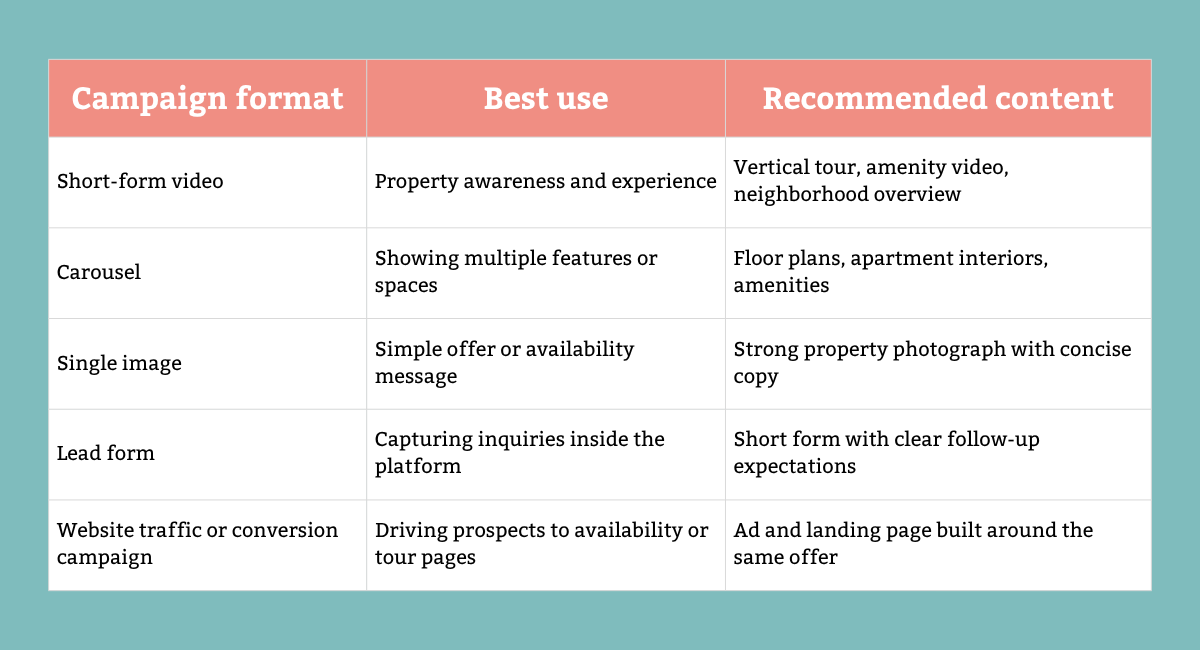
A polished video can introduce the community, while a carousel can provide more detail. Single-image ads can still work when the photograph and offer are strong.
The campaign should be designed around what prospects need to understand—not around which content format happens to be easiest to produce.
Step 9: Build a Practical Testing Plan
Testing allows the property to learn which messages and visuals generate stronger leasing actions.
Start by testing meaningful differences, such as:
Apartment interiors versus amenities
Video tours versus carousel ads
Floor-plan messaging versus lifestyle messaging
“View Availability” versus “Schedule a Tour”
Property-focused copy versus location-focused copy
One-bedroom messaging versus two-bedroom messaging
Avoid changing the audience, creative, copy, placement, landing page, and call to action all at once. If everything changes, the team will not know what caused the result.
Give each test enough time and budget to collect useful information before declaring a winner. A decision based on a handful of clicks is closer to a hunch than an optimization strategy.
Step 10: Optimize Based on Leasing Outcomes
Campaign optimization means adjusting the advertisement, budget, placement, landing page, or follow-up process using performance data.
Review metrics at several levels.
Advertising Metrics
Reach
Frequency
Video views
Click-through rate
Cost per click
Landing-page views
Cost per lead
Website and Leasing Metrics
Floor-plan views
Availability searches
Tour requests
Phone calls
Application starts
Completed applications
Cost per qualified lead
Cost per scheduled tour
Cost per application
Cost per signed lease, when attribution is available
A low cost per click does not automatically mean the campaign is working. Cheap traffic that never produces a leasing action is still expensive traffic.
What Content Works Best for Apartment Advertising?
The strongest apartment advertising content answers the questions prospective renters are already asking: What does the apartment look like? What is available? What does it cost? Where is it located? What amenities are included? How can I schedule a tour?
Apartment and Floor-Plan Tours
Video tours help prospects understand the flow, scale, finishes, storage, and layout of an apartment.
Capture the complete path through the unit rather than combining disconnected detail shots. Include the kitchen, living area, bedrooms, bathrooms, closets, outdoor space, and notable features.
Community Amenity Content
Show actual amenities such as:
Fitness centers
Pools
Coworking areas
Resident lounges
Package rooms
Outdoor kitchens
Parking facilities
Pet-related amenities
Bike storage
Shared outdoor spaces
Describe amenities accurately. If access, hours, fees, or availability are limited, that information should not be misrepresented.
Location and Neighborhood Content
Location-based content can explain access to factual destinations such as:
Major employers
Universities
Public transportation
Highways
Grocery stores
Parks
Entertainment districts
Restaurants and retail
Avoid subjective neighborhood descriptions that may carry fair housing implications. Focus on verifiable distances, transportation options, and nearby destinations.
Resident Experience Content
With appropriate permission, content can highlight property programming, services, maintenance processes, and shared spaces.
Use caution with resident images and testimonials. Obtain the necessary releases and review whether the overall representation is inclusive and compliant.
Leasing Information Content
Helpful advertising does not need to hide every detail behind a form.
Content can explain:
How to schedule a tour
What to bring to a tour
How the application process works
Which documents may be needed
How fees are structured
When units are expected to become available
How virtual tours work
Educational content can reduce confusion and help leasing teams spend more time with better-informed prospects.
How Much Should an Apartment Community Spend on Social Media Ads?
An apartment advertising budget should be based on the leasing goal, market size, occupancy needs, average lead-to-lease performance, campaign duration, and cost of vacant units.
There is no responsible universal budget that works for every property.
A stabilized community promoting occasional availability will have different needs from a new development entering lease-up. Before selecting a budget, identify:
The number of units that need to be leased
The campaign’s geographic market
The campaign duration
The property’s average lead-to-tour rate
The average tour-to-application rate
The average application-to-lease rate
The estimated value or cost associated with filling a vacancy
The creative and management costs outside media spend
Start with a controlled test budget that can produce enough data to evaluate the campaign. Increase spending only after the advertisements, landing page, tracking, and lead follow-up are working together.
How Should Apartment Marketing Leads Be Followed Up?
Apartment leads should receive a prompt, helpful, and consistent response that answers their question and guides them toward the next appropriate leasing step.
A practical follow-up process may include:
Confirm that the inquiry was received.
Provide the requested information.
Offer available tour times.
Explain how to view current pricing or availability.
Assign the inquiry to a leasing-team member.
Record the source of the lead.
Continue follow-up according to the prospect’s preferences and applicable communication rules.
Document the final outcome.
The advertising campaign cannot compensate for slow or inconsistent follow-up. If an inquiry sits untouched for days, the marketing budget is essentially paying to introduce prospects to voicemail.
Common Apartment Advertising Mistakes to Avoid
Using Noncompliant Targeting or Advertising Language
Housing advertisements require additional care. Review targeting, copy, images, landing pages, and automated tools for fair housing compliance.
Promoting the Property Without Showing Availability
Beautiful amenity content can create interest, but prospects also need current information about available apartments and the next step.
Sending Every Advertisement to the Homepage
Use a campaign-specific page that continues the message from the advertisement.
Optimizing Only for Clicks
Clicks are not leases. Track tour requests, calls, applications, and qualified leasing outcomes whenever possible.
Using Generic Stock Photography
Prospects want to see the actual property. Use authentic photography and video whenever possible.
Hiding Important Offer Conditions
If a concession applies only to selected units or lease terms, explain the conditions clearly.
Ignoring the Leasing Team’s Feedback
Marketing data shows what happens online. The leasing team can explain lead quality, recurring questions, objections, and reasons prospects do not move forward.
Leaving the Same Creative Active Indefinitely
Apartment availability, offers, seasons, and audience response change. Refresh creative before it becomes outdated or overexposed.
Which Social Media Advertising Approach Is Right for Your Property?
The right approach depends on the property’s leasing stage and immediate business needs.
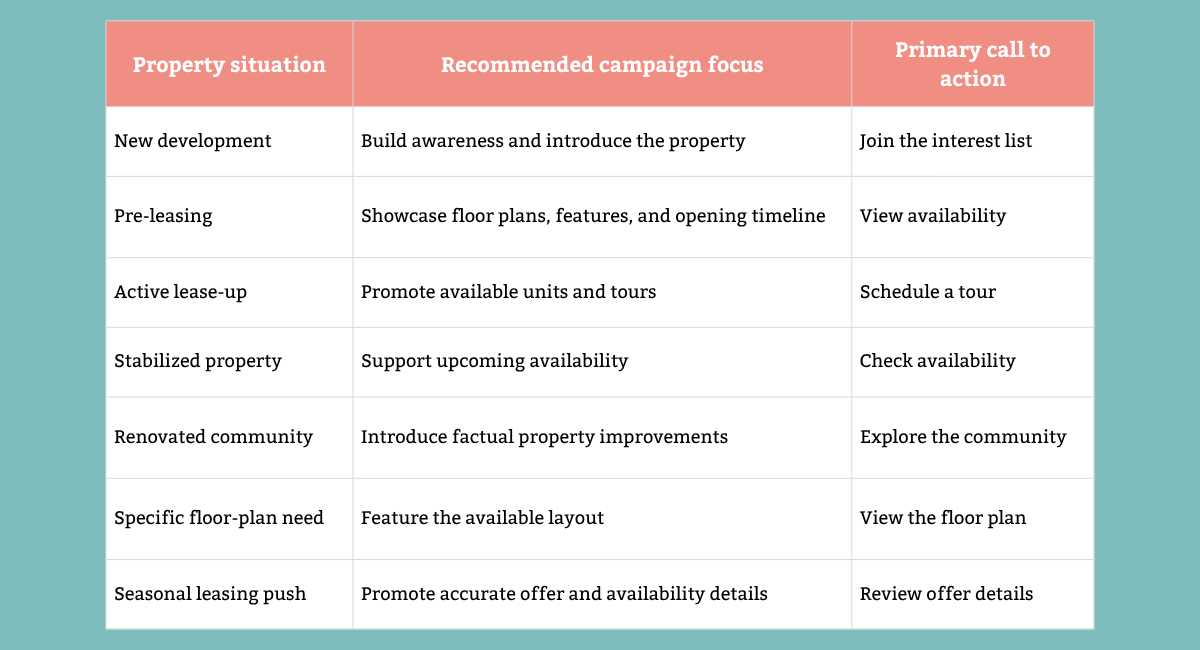
Campaigns should reflect actual inventory and operational priorities. Marketing a floor plan that is unavailable wastes budget and frustrates prospects.
Frequently Asked Questions About Apartment Marketing Campaigns
Which Social Media Platform Is Best for Apartment Advertising?
Meta’s Facebook and Instagram platforms are common choices for visual apartment advertising because they support images, videos, carousels, lead forms, and website campaigns.
The best platform depends on the property’s market, creative resources, leasing goals, platform policies, and measurement capabilities. Housing advertisers must follow the applicable advertising restrictions on every platform they use.
Do Apartment Ads Need to Use Meta’s Special Ad Category?
Applicable advertisements promoting housing must be identified under Meta’s housing-related Special Ad Category. Meta applies additional audience restrictions to these campaigns.
Advertisers should review Meta’s current instructions before launch because features and policies can change.
Can Apartment Communities Retarget Website Visitors?
Retargeting options for housing advertisements may be limited by platform policies and applicable law. The availability of a technical feature does not automatically mean it is appropriate for every housing campaign.
Review current platform rules, privacy requirements, consent practices, and fair housing obligations before using remarketing or customer data.
What Is a Good Call to Action for Apartment Ads?
Effective apartment-advertising calls to action include “View Availability,” “Schedule a Tour,” “Explore Floor Plans,” “Contact the Leasing Team,” and “Join the Interest List.”
The best choice is the one that matches the campaign goal and the page prospects will see after clicking.
Should Apartment Ads Include Pricing?
Including accurate pricing can help prospects evaluate whether an apartment fits their needs and may reduce unqualified inquiries. However, rent, fees, availability, and concessions can change.
If pricing is used, establish a process for keeping the advertisement and landing page accurate. Clearly explain whether a price is a starting rate and whether additional fees or conditions apply.
How Do You Measure Whether Apartment Ads Are Working?
Measure apartment advertising using both marketing and leasing results.
Useful performance indicators include landing-page views, calls, qualified leads, tour requests, applications, signed leases, cost per qualified lead, cost per tour, and cost per lease when reliable attribution is available.
How Often Should Apartment Ad Creative Be Updated?
Creative should be reviewed regularly and updated when availability, pricing, concessions, seasons, property features, or campaign performance change.
There is no universal replacement schedule. Monitor frequency, engagement, conversion performance, comments, and leasing feedback for signs that the content is outdated or losing effectiveness.
Can AI Be Used to Create Apartment Advertisements?
AI can help develop concepts, draft copy variations, organize performance data, and streamline campaign workflows. Human review remains essential.
HUD has stated that the Fair Housing Act applies to housing advertising even when artificial intelligence or algorithms are involved. AI-generated copy, images, targeting decisions, and automated processes should be reviewed for accuracy, fairness, accessibility, and compliance.
Build an Apartment Marketing Campaign That Supports Leasing
Effective apartment marketing is not about generating the largest possible number of clicks. It is about connecting accurate property information with prospective renters, providing an easy path to the next step, and helping the leasing team convert qualified interest into tours, applications, and leases.
The strongest social media campaigns combine compliant audience selection, authentic property content, focused landing pages, reliable tracking, and timely follow-up.
Eat It Up Marketing helps brands develop social media content, paid media campaigns, creative assets, and performance strategies built around measurable business goals. For multifamily properties, that means creating a connected digital experience that supports the leasing process without losing sight of fair housing responsibilities.
Ready to Strengthen Your Apartment Marketing?
Talk with Eat It Up Marketing about developing a social media and paid media strategy designed around your property, leasing priorities, and market.
