
How CPG Brands Can Prepare Their Holiday Marketing Strategy

For consumer packaged goods brands, holiday marketing should start well before the holiday decorations come out. A strong holiday marketing strategy for CPG brands aligns product, creative, content, promotions, retail partners, paid media, and inventory before consumers enter peak shopping mode.
And consumers do start early. The National Retail Federation reports that roughly two in five holiday shoppers begin browsing and buying before November, while retailers have responded by putting seasonal merchandise and promotions into market earlier.
Translation? If your CPG brand waits until November to think about holiday marketing, you may already be late to the party.
Holiday Marketing for CPG Brands: Key Takeaways
Before we get into the details, here’s the short version:
Start holiday planning in late summer or early fall, not November.
Decide which products, bundles, or seasonal offerings you want to prioritize.
Build a holiday creative library before your campaign launches.
Give consumers a reason to buy, gift, share, or serve your product.
Coordinate organic social, creators, email, retail partners, and paid media.
Plan for multiple holiday moments rather than putting everything behind one December campaign.
Measure more than likes. Track traffic, clicks, conversions, retailer activity, sales, and other KPIs available to your brand.
Holiday marketing works best as a coordinated campaign, not a collection of festive posts.
Why Should CPG Brands Start Holiday Marketing Early?
CPG brands should prepare early because consumers are shopping earlier and brands need enough time to develop creative, coordinate partners, secure inventory, plan promotions, and build awareness before purchase decisions happen.
NRF reported that 2025 holiday retail sales surpassed $1 trillion, with November and December sales increasing 4.1% over 2024. NRF also found that consumers planned to spend an average of about $890 on gifts, food, decorations, and other seasonal items.
For food, beverage, beauty, wellness, and other CPG brands, the opportunity extends beyond traditional gifting. Your product might become part of a holiday dinner, cocktail, hotel welcome amenity, party, hostess gift, stocking stuffer, corporate gift, or New Year’s celebration.
The goal is to identify where your product naturally fits before you start creating content.
When Should CPG Brands Start Planning for the Holidays?
For many brands, August through October is a valuable planning and production window, while October through December becomes increasingly focused on execution.
Your exact timeline will depend on retail relationships, inventory, shipping, production, and campaign complexity, but a practical framework looks like this:
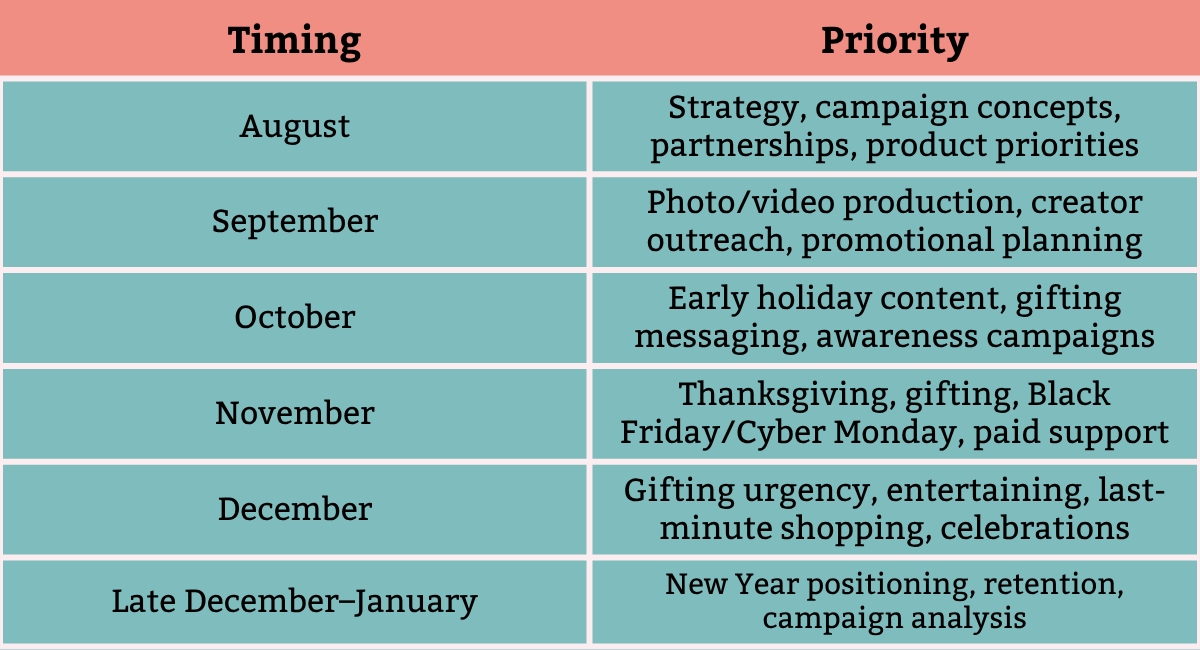
This timeline should be adjusted to your specific production, distribution, retailer, and fulfillment deadlines.
What Should a CPG Holiday Marketing Strategy Include?
A strong holiday campaign connects the product to a specific consumer need or occasion. Before deciding what to post, answer a more important question: Why does someone need this product during the holidays?
1. Choose the Holiday Moments Your Brand Can Own
Instead, identify the moments where your product has a natural role. That could include:
Thanksgiving hosting
Friendsgiving
Holiday parties
Host and hostess gifts
Stocking stuffers
Corporate gifting
Christmas and Hanukkah gifting
Holiday travel
New Year’s Eve
Dry January or New Year wellness
Seasonal recipes and entertaining
A mixer brand, for example, could focus on holiday entertaining and easy batch cocktails. A specialty food brand could create hostess-gift bundles and recipes. A wellness product might make more sense as part of travel, gifting, or New Year routines.
Your holiday campaign should feel like an extension of how people actually use your product.
2. Give Your Product a Holiday Story
Putting a bow next to your product does not automatically make it holiday content.
Show the product in context.
Instead of simply photographing a bottle, show it being poured during a dinner party. Turn packaged foods into a holiday recipe. Show a giftable product being wrapped. Capture friends bringing the product to a gathering.
This is where strong content creation becomes especially important. Holiday assets should help customers visualize when, where, why, and with whom they would use the product.
For brands with hospitality connections, the opportunities get even more interesting. A beverage brand could collaborate with a restaurant on a seasonal cocktail. A winery could create a holiday pairing dinner. A snack brand could partner with a hotel on an in-room welcome package.
One product can generate an entire ecosystem of holiday stories.
3. Build Your Content Library Before You Need It
Holiday content should ideally be produced before the campaign begins.
A single strategic shoot can capture:
Product photography
Lifestyle photography
Short-form video
Recipe demonstrations
Gift guides
Unboxing content
Entertaining ideas
Behind-the-scenes footage
Creator-style videos
Paid advertising creative
Website and email imagery
Think beyond December 25, too. Capture assets that can transition into New Year’s Eve, winter entertaining, January, and evergreen winter content.
The goal is to walk away with a flexible content library, not one hero image you have to stretch across six weeks.
How Can CPG Brands Use Influencers and Creators During the Holidays?
CPG brands can use creators to demonstrate the product in real-life situations, introduce it to new audiences, and produce relatable content that can potentially extend beyond the creator’s own feed.
The best partnership is not necessarily the creator with the largest following. Look for creators whose audience, content style, geography, and interests align with your customer.
A Texas wine brand, for example, might work with food, wine, travel, and entertaining creators in San Antonio, Austin, Dallas, and Houston. A national packaged-food brand could prioritize recipe creators who can naturally integrate the product into holiday cooking.
Before confirming a partnership, establish:
Deliverables
Usage rights
Posting dates
Required disclosures
Approval expectations
Key messages
Exclusivity, if applicable
Reporting requirements
Whether the brand can use the content in paid advertising
Ask creators for their media kit and relevant performance information when evaluating a paid partnership.
Most importantly, give creators room to create. A recommendation feels much more natural when the product fits their usual content instead of reading like a script handed down by a brand.
How Should Paid Media Support a Holiday CPG Campaign?
Paid media can extend the reach of strong holiday creative and put specific products, offers, or messages in front of audiences beyond your existing organic following.
Rather than waiting until the final shopping days, brands can use paid campaigns at different stages.
Awareness: Introduce the product and holiday use case.
Consideration: Reinforce recipes, gifting ideas, reviews, creator content, or product benefits.
Conversion: Promote a clear offer, retailer destination, ecommerce page, or other purchase path.
Retargeting: Reconnect with people who have already visited your website, engaged with content, or otherwise entered an eligible audience.
The exact media mix should depend on where the product is sold and how conversions can be measured. A direct-to-consumer brand may have much clearer ecommerce attribution than a CPG brand primarily sold through third-party retailers.
Don’t Forget the Hospitality Side of CPG Marketing
For food and beverage CPG brands, restaurants, hotels, bars, wineries, resorts, tourism destinations, and event venues can become valuable parts of a holiday marketing strategy.
Instead of thinking only about traditional advertising, consider how consumers could actually experience the product.
A few examples:
A spirits or mixer brand featured in a restaurant’s seasonal cocktail
A packaged snack included in a hotel welcome amenity
A winery hosting a holiday pairing dinner
A local product featured in a resort gift shop
A beverage brand sponsoring a holiday market or event
A CPG brand partnering with a chef on a seasonal recipe
A giftable product included in a corporate or hotel holiday package
These partnerships can create content, trial, visibility, and a tangible connection between the brand and the holiday experience.
How Do You Choose the Right Holiday Marketing Approach?
Start with your business goal rather than a marketing channel.
If your goal is awareness, prioritize high-quality creative, social media, creators, partnerships, public relations, and paid reach.
If your goal is ecommerce sales, prioritize conversion-focused creative, email, paid media, retargeting, optimized product pages, offers, and clear calls to action.
If your goal is retail visibility, coordinate marketing with retailer availability and make it easy for consumers to understand where they can find the product.
If your goal is local market penetration, consider local creators, hospitality partnerships, events, sampling opportunities, and geographically targeted advertising.
The right strategy may combine several of these approaches, but each channel should support the same campaign objective.
Common Holiday Marketing Mistakes CPG Brands Should Avoid
Starting too late. Consumers may begin shopping before your brand enters holiday mode. NRF notes that roughly two in five holiday shoppers start before November.
Making everything look “holiday” without having a strategy. Seasonal colors and snowflakes are creative decisions, not a marketing plan.
Trying to participate in every holiday moment. Choose occasions that make sense for your product and audience.
Creating content without a distribution plan. Before a shoot, determine what you need for organic social, paid media, email, ecommerce, retailers, creators, and other channels.
Ignoring the purchase path. Great content loses value when customers cannot quickly figure out where to buy the product.
Only measuring engagement. Likes and comments can tell part of the story, but brands should also evaluate metrics tied to their goals, such as reach, traffic, clicks, conversions, sales, retailer activity, and creator performance where that data is available.
Your CPG Holiday Marketing Checklist
Before your holiday campaign goes live, confirm that you have:
Defined your primary holiday objective
Identified priority products
Selected the occasions your brand will participate in
Confirmed inventory and fulfillment considerations
Developed the campaign concept
Completed seasonal photography and video
Planned organic social content
Identified creator or influencer opportunities
Coordinated retailer or hospitality partnerships
Built email campaigns, if applicable
Developed paid media creative and audiences
Confirmed product and retailer links
Established tracking and campaign KPIs
Planned your post-holiday transition
If several of these items are still undecided by late fall, the problem usually is not a lack of holiday content. It is a lack of campaign planning.
Start Your CPG Holiday Marketing Before the Rush
The strongest holiday marketing strategy for CPG brands connects planning, creative, partnerships, distribution, and measurement around the moments when customers are most likely to want the product.
Start early enough to be intentional. Determine where your product fits into the season, build the right creative assets, and then use social media, creators, paid media, email, retail, and real-world experiences to tell one consistent story.
Eat It Up Marketing works with hospitality-driven businesses, CPG brands, and lifestyle brands to build thoughtful digital marketing strategies and content designed around their audiences and business goals.
If your brand needs help turning holiday ideas into an actual campaign plan, we’d love to talk.
Frequently Asked Questions About CPG Holiday Marketing
When should CPG brands start planning holiday marketing?
CPG brands should generally begin strategic planning several months before peak holiday shopping. The exact timing depends on production, inventory, retail relationships, fulfillment, content needs, and campaign complexity. Because many consumers begin holiday shopping before November, waiting until the holiday season is underway can limit your options.
What should a CPG holiday campaign include?
A CPG holiday campaign can include seasonal creative, social media, creator partnerships, email marketing, paid media, retail support, promotions, experiential activations, and clear purchase paths. The exact mix should be based on the campaign’s primary business goal.
Should CPG brands work with influencers during the holidays?
Influencer and creator partnerships can be useful when the creator’s audience and content style align with the brand. Holiday partnerships work particularly well when creators can demonstrate a natural gifting, entertaining, recipe, travel, or seasonal use case for the product.
What holiday content works for food and beverage brands?
Useful formats include seasonal recipes, entertaining ideas, pairings, gift guides, product demonstrations, creator content, behind-the-scenes videos, hospitality collaborations, and lifestyle photography showing the product being enjoyed in a realistic setting.
How should CPG brands measure holiday marketing performance?
Measurement should match the campaign objective. Depending on the brand and available data, useful metrics can include reach, engagement, website traffic, link clicks, conversions, e-commerce revenue, retailer traffic, creator performance, email activity, and paid-media results.
