
Best Digital Tools for Hospitality Marketing Campaigns

Hospitality marketing moves quickly. A restaurant may need to promote a last-minute event, a hotel may need to increase midweek bookings, and a tourism brand may need to reach travelers before they finalize their plans.
The best digital tools for hospitality marketing campaigns help businesses manage social media, reach high-intent customers, automate guest communication, improve local visibility, and measure which campaigns generate real revenue.
For most hospitality brands, an effective digital marketing toolkit includes:
Google Business Profile for local visibility
Later for social media planning and scheduling
Canva for accessible creative production
Meta Ads Manager for social advertising and retargeting
Google Ads for capturing high-intent searches
An email and CRM platform for guest retention
Google Analytics 4 for website performance
Google Search Console for organic search visibility
Data Studio for campaign reporting
Asana for marketing project management
The right combination depends on your business, budget, team, and marketing goals. More software does not automatically mean better marketing. Sometimes it just means more passwords to forget.
Why Hospitality Businesses Need the Right Marketing Tools
Hospitality marketing is different from marketing many other products and services. Restaurants, hotels, resorts, bars, wineries, event venues, and tourism brands must influence decisions that are often emotional, visual, local, and time-sensitive.
A potential guest may discover a restaurant through Instagram, read its Google reviews, view the menu, visit the website, and then make a reservation. A traveler may see a hotel advertisement, leave without booking, and return days later after receiving another advertisement or email.
Digital marketing tools help connect these interactions throughout the guest journey.
Discovery
Social media, search engines, digital advertising, creator content, and online reviews introduce potential guests to the brand.
Consideration
Websites, menus, photography, videos, reviews, and guest testimonials help people evaluate the experience.
Conversion
Reservation systems, booking engines, phone calls, forms, and online ordering platforms turn interest into action.
Retention
Email, SMS, loyalty programs, and retargeting campaigns encourage guests to return.
Measurement
Analytics and reporting tools help identify which campaigns contribute to reservations, bookings, visits, and revenue.
1. Google Business Profile for Local Hospitality Marketing
Google Business Profile is one of the most important—and often most underused—marketing tools for hospitality businesses.
A properly managed profile helps a business appear across Google Search and Google Maps. Restaurants can display menus, hours, photos, reviews, reservation options, and ordering links. Hotels can showcase accommodations, amenities, availability, and guest experiences.
Hospitality businesses should regularly update:
Business hours and holiday hours
Website and reservation links
Menus, services, and amenities
High-quality photos and videos
Google Posts
Business categories and attributes
Questions and answers
Responses to guest reviews
Google Business Profile is especially valuable for location-based searches such as “restaurants near me,” “boutique hotels in San Antonio,” or “wineries open this weekend.”
Who Should Use Google Business Profile?
Google Business Profile is especially valuable for restaurants, hotels, bars, spas, wineries, attractions, and event venues that depend on local customers or travelers.
What Is Google Business Profile Best For?
It is best for increasing local discovery, website visits, phone calls, requests for directions, reservations, and bookings.
Google Business Profile is free, making it an essential starting point for nearly every hospitality business.
2. Later for Social Media Management
Hospitality marketing depends heavily on visual storytelling. Later helps teams plan, organize, schedule, and analyze content across multiple social media platforms.
A restaurant can use Later to schedule menu features, chef stories, events, and seasonal promotions. A hotel can organize content around rooms, amenities, dining outlets, weddings, spa services, and local travel experiences.
Useful Later features include:
Social media scheduling
Visual content planning
Content approval workflows
Performance analytics
Link-in-bio tools
Creator and influencer campaign support
Scheduling software saves time, but it should not turn social media into an autopilot system. Hospitality brands still need to monitor comments, answer questions, share timely content, and interact with their communities.
Who Should Use Later?
Later is a strong option for hospitality brands that publish visual content across Instagram, Facebook, TikTok, Pinterest, and other social platforms.
What Is Later Best For?
Later is best for maintaining a consistent publishing schedule, organizing content calendars, collaborating on approvals, and reviewing social media performance.
Alternatives include Sprout Social, Hootsuite, and Buffer.
3. Canva for Hospitality Marketing Creative
Canva is a practical creative platform for producing social graphics, email banners, event promotions, digital advertisements, menus, presentations, and other branded materials.
Hospitality teams can create templates for recurring needs such as:
Weekly specials
Happy-hour promotions
Hotel packages
Seasonal menus
Live music announcements
Wedding and event promotions
Email campaigns
Social media Stories
Digital advertisements
Brand templates help keep colors, fonts, logos, and visual styles consistent across campaigns and locations.
Canva is not a replacement for professional photography, videography, branding, or high-level design. A beautiful template cannot rescue blurry food photography from the witness protection program. It is best used to help teams adapt and distribute strong creative assets efficiently.
Who Should Use Canva?
Canva is useful for restaurants, hotels, bars, venues, tourism brands, and marketing teams that need to produce branded materials quickly.
What Is Canva Best For?
Canva is best for fast creative production, maintaining brand consistency, and adapting professional assets into different marketing formats.
Adobe Express is another option for teams looking for similar creative capabilities.
4. Meta Ads Manager for Social Advertising and Retargeting
Meta Ads Manager allows hospitality businesses to run paid campaigns across Facebook and Instagram.
Organic social media reaches only part of a brand’s potential audience. Paid media helps hospitality businesses reach specific geographic markets, promote priority offers, and reconnect with people who have already shown interest.
Hospitality businesses can create audiences based on:
Geographic location
Interests and behaviors
Website visits
Social media engagement
Video views
Customer or guest lists
Previous reservation or purchase activity, when properly integrated
Retargeting is particularly important. Someone who viewed a hotel package, visited a restaurant menu, or engaged with an event announcement has already demonstrated interest. Retargeting keeps the brand visible while that person decides what to do next.
What Can Hospitality Businesses Promote Through Meta Ads?
Meta advertising campaigns can support:
Restaurant reservations
Hotel bookings
Event ticket sales
Wedding and group inquiries
Spa appointments
Online orders
Website traffic
Seasonal promotions
Brand awareness
What Is Meta Ads Manager Best For?
Meta Ads Manager is best for visual advertising, local audience targeting, brand awareness, offer promotion, and retargeting previous website visitors or social media engagers.
5. Google Ads for Capturing High-Intent Demand
Social media can create demand. Google Ads helps capture demand that already exists.
A person searching for “Italian restaurant in San Antonio,” “hotel near the River Walk,” or “Hill Country wedding venue” may be much closer to making a decision than someone casually scrolling through social media.
Google Ads can help hospitality businesses appear for relevant searches and guide potential guests toward focused landing pages.
Effective hospitality campaigns require:
Intent-focused keyword targeting
Geographic targeting
Negative keywords
Relevant advertising copy
Dedicated landing pages
Conversion tracking
Call and reservation tracking
Ongoing bid and budget optimization
Sending every advertisement to a general homepage is rarely the best approach. The landing page should directly match the search. A wedding-venue advertisement should lead to wedding information—not make the visitor hunt through the website like a digital scavenger hunt.
Who Should Use Google Ads?
Google Ads is useful for hospitality businesses that want to reach people actively searching for restaurants, accommodations, venues, experiences, services, or events.
What Is Google Ads Best For?
Google Ads is best for generating reservations, direct bookings, phone calls, online orders, qualified inquiries, and website visits from high-intent searches.
6. Email Marketing and Hospitality CRM Platforms
Email marketing helps hospitality businesses turn one-time visitors into repeat guests.
The best platform depends on how much guest data the business has and how deeply the platform needs to integrate with its reservation, point-of-sale, booking, or property-management system.
General email platforms such as Mailchimp or Klaviyo can support:
Newsletters
Event announcements
Seasonal promotions
Audience segmentation
Automated email sequences
Customer re-engagement
Hospitality-focused platforms may offer deeper integrations with guest activity. Hotel platforms such as Revinate can connect marketing to guest and stay data, while restaurant platforms such as SevenRooms can use reservation activity and guest profiles to support more personalized communication.
Which Email Automations Should Hospitality Businesses Use?
Useful automated campaigns include:
Welcome emails
Reservation reminders
Pre-arrival offers
Birthday and anniversary messages
Post-visit review requests
Abandoned-booking reminders
Lapsed-guest campaigns
Loyalty and VIP offers
What Are Hospitality CRM Platforms Best For?
Email and CRM platforms are best for guest retention, personalized communication, direct bookings, repeat visits, loyalty programs, and increasing the lifetime value of existing customers.
7. Google Analytics 4 for Website Measurement
Google Analytics 4, commonly called GA4, helps hospitality businesses understand how visitors find and use their websites.
GA4 can provide insights into:
Website traffic sources
Popular pages
User behavior
Advertising campaign traffic
Geographic markets
Booking-engine clicks
Reservation-link clicks
Form submissions
Calls and other conversions
Hospitality businesses should configure meaningful events instead of relying only on pageviews. A visitor looking at a menu is useful information, but a visitor clicking “Reserve a Table” is much more closely tied to business performance.
Whenever possible, GA4 should be paired with proper advertising tracking and reservation or booking data. Otherwise, a campaign may appear successful because it generated traffic without proving whether that traffic created customers.
What Should Hospitality Businesses Track in GA4?
Important hospitality website conversions may include:
Reservation-button clicks
Booking-engine visits
Online orders
Phone calls
Contact-form submissions
Wedding or event inquiries
Menu downloads
Email signups
Offer or package views
What Is Google Analytics 4 Best For?
GA4 is best for understanding website behavior and identifying which marketing channels influence valuable guest actions.
The standard version of Google Analytics 4 is free.
8. Google Search Console for SEO Performance
Google Search Console shows how a website performs in organic Google search results.
Hospitality marketers can use it to identify:
Search terms generating visibility
Pages appearing in search results
Click-through rates
Keyword and page-ranking trends
Website indexing problems
Mobile usability issues
Opportunities to improve existing content
For example, a hotel might discover that its website appears for searches related to pet-friendly accommodations but receives very few clicks. That insight could support a stronger page about its pet-friendly rooms, policies, amenities, and nearby activities.
Google Search Console also helps businesses determine whether their blog posts, location pages, and service pages are being discovered by Google.
What Is Google Search Console Best For?
Google Search Console is best for measuring organic search performance, discovering content opportunities, identifying technical issues, and improving qualified website traffic.
Google Search Console is free.
9. SEO Platforms for Search and AI Visibility
Platforms such as Semrush, Ahrefs, and Ubersuggest can help hospitality brands research topics, evaluate competitors, find keyword opportunities, and monitor search visibility.
These tools may support:
Keyword research
Competitor analysis
Website audits
Backlink monitoring
Content planning
Ranking reports
Local search research
Brand and AI visibility monitoring
Hospitality businesses should focus on useful questions and actual guest needs instead of forcing the same keyword into every paragraph.
What Hospitality Questions Should Website Content Answer?
Hospitality businesses can create content answering questions such as:
What are the best restaurants for a group dinner in San Antonio?
When is the best time to visit the Texas Hill Country?
What should a hotel wedding package include?
How far in advance should guests reserve a private dining room?
Which hotel amenities matter most for business travelers?
How can restaurants attract more local customers?
What should guests look for when selecting an event venue?
Clear, specific answers can improve traditional SEO while making the content easloier for AI-powered search engines to understand, summarize, and reference.
What Are SEO Platforms Best For?
SEO platforms are best for keyword research, competitive intelligence, website audits, content planning, organic visibility, and monitoring performance across traditional and AI-assisted search.
10. Data Studio for Hospitality Marketing Reports
Data Studio can combine information from multiple marketing channels into a visual dashboard.
A hospitality marketing dashboard might include:
Website traffic
Organic search performance
Social media results
Advertising reach and clicks
Cost per conversion
Reservation-link activity
Email performance
Geographic audience data
Revenue or booking data, when available
Reporting should connect marketing activity to business outcomes. Followers, impressions, and video views provide useful context, but leadership ultimately needs to understand whether marketing is helping generate reservations, bookings, qualified inquiries, visits, and revenue.
What Is Looker Studio Best For?
Data Studio is best for consolidating marketing data, creating performance dashboards, identifying trends, and turning scattered campaign metrics into usable business insights.
11. Asana for Hospitality Marketing Project Management
Hospitality campaigns involve more moving parts than most guests ever see. Photography, approvals, menus, advertisements, events, landing pages, email campaigns, and social content may involve several departments or outside partners.
Asana can help organize:
Campaign timelines
Content calendars
Photo and video production
Approval deadlines
Advertising launches
Website updates
Email campaigns
Event marketing
Team responsibilities
A project-management platform helps prevent campaigns from being delayed because one image, menu, link, or approval disappeared into a crowded email thread.
What Is Asana Best For?
Asana is best for campaign coordination, team accountability, approval management, deadlines, and organizing marketing deliverables.
Alternatives include Monday.com and Trello.
How to Choose the Right Hospitality Marketing Tools
Before investing in another platform, hospitality businesses should consider five important questions.
Does the Tool Support a Specific Business Goal?
Every platform should help improve visibility, generate conversions, retain guests, save time, or strengthen reporting. Avoid investing in technology simply because it is popular.
Does It Integrate With Existing Systems?
The strongest hospitality marketing technology connects with reservation systems, booking engines, property-management systems, point-of-sale platforms, websites, and analytics tools.
Can the Team Realistically Manage It?
A sophisticated platform has little value if no one has the time or knowledge to use it properly. Consider who will be responsible for setup, ongoing management, reporting, and optimization.
Can It Track Meaningful Results?
Choose tools that help connect marketing activity to reservations, bookings, orders, leads, repeat visits, and revenue—not just impressions and clicks.
Does It Improve the Guest Experience?
Marketing automation should make communication more relevant and timely. It should not make guests feel as if they are being followed around the internet by a coupon with trust issues.
What Is the Best Hospitality Marketing Technology Stack?
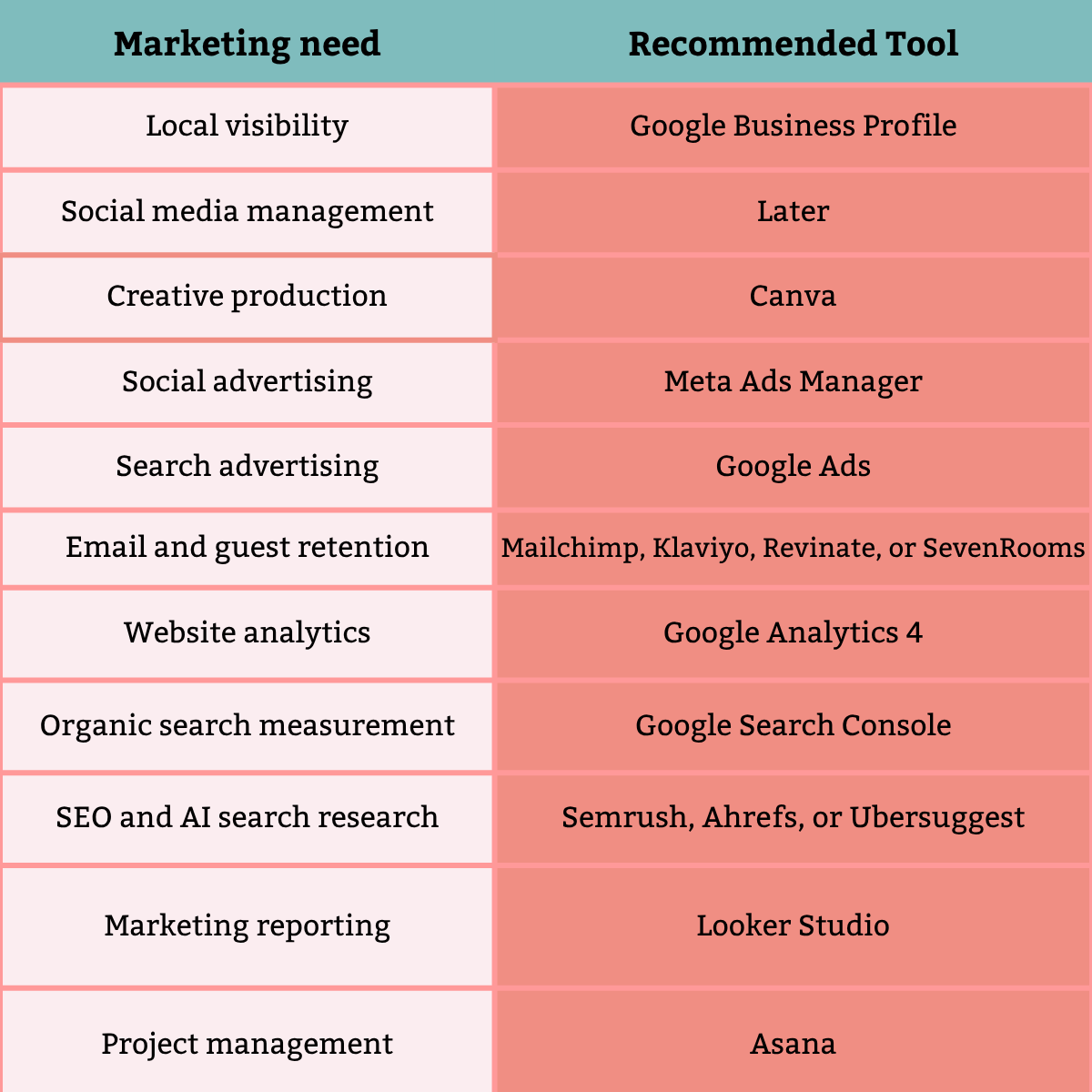
There is no universal marketing technology stack, but a practical starting point for a restaurant, independent hotel, winery, resort, or hospitality venue may include:
Frequently Asked Questions
What Are the Best Digital Marketing Tools for Restaurants?
A strong restaurant marketing toolkit includes Google Business Profile, Later, Canva, Meta Ads Manager, Google Ads, Google Analytics 4, and an email or restaurant CRM platform.
The exact combination depends on whether the restaurant is prioritizing reservations, online orders, private events, catering, brand awareness, or repeat visits.
What Marketing Tools Should Hotels Use?
Hotels should consider Google Business Profile, Google Ads, Meta Ads Manager, GA4, Google Search Console, a hospitality CRM, an email automation platform, reputation-management software, and analytics connected to the hotel’s booking engine.
What Is the Most Important Hospitality Marketing Tool?
Google Business Profile is one of the most important tools for local hospitality businesses because it directly affects how they appear across Google Search and Maps.
However, Google Business Profile works best as part of a connected strategy that also includes a strong website, guest reviews, content, digital advertising, and customer retention.
Can Hospitality Businesses Use AI Marketing Tools?
Yes. AI marketing tools can assist with research, content development, audience analysis, advertising variations, reporting, and workflow automation.
Hospitality businesses should still review AI-generated work for accuracy, brand voice, originality, and relevance. AI can accelerate a strong marketing strategy, but it cannot invent one from thin air.
How Much Should a Hospitality Business Spend on Marketing Software?
The appropriate budget depends on the size of the business, number of locations, internal team, required integrations, and campaign goals.
Begin with essential platforms, eliminate overlapping subscriptions, and evaluate every tool based on the time it saves or the revenue it helps influence.
Build a Connected Hospitality Marketing Strategy
Digital tools are most effective when they work together.
Social media can introduce the experience. Paid advertising can expand its reach. Google can capture active demand. Email can bring previous guests back. Analytics can show which interactions contributed to business results.
The goal is not to collect more software. The goal is to create a connected marketing system that turns attention into measurable guest action.
Eat It Up Marketing helps restaurants, hotels, tourism brands, and hospitality businesses develop integrated strategies across social media, content creation, paid advertising, search, email, and digital performance measurement.
Ready to Improve Your Hospitality Marketing Campaigns?
Contact Eat It Up Marketing to build a hospitality marketing strategy designed around your guests, business goals, and growth opportunities.
